My Hands Don't Draw Like That: Living and Working With Dysgraphia
As many of you are aware, I am a disabled artist. Some galleries and art professionals have received my Disability Rider when relevant to our working relationship, which details some of my many accessibility needs, but not all of them. It also does not go into full detail of all of my diagnoses. In fact, I often just say I am Autistic and Dyslexic to people, or just Neurodivergent because it can feel like I am delivering a memoir if I list all of my diagnoses.
Despite that, I felt it was time to talk about another of my diagnoses because I don’t see it talked about much in creative industries. I want to talk about how it affects me on a daily basis, not for sympathy, but to make readers consider the reality of what some creatives are having to deal with on a daily basis and give just a bit more consideration when they do things in a non-conventional way or no longer have the energy to turn up to another opening that week.
Imagine being sat in a meeting regarding an upcoming Exhibition Opening Evening; you need to take notes so you don’t miss any important actionable information. But you can’t. Your hand cannot move fast enough; you skip out words, you write backwards, you have to cross out whole sentences in frustration because they don’t make any sense. Your hands are burning, the pen is driving itself into your fingers, leaving painful imprints, and your hand starts to lock into an unusual shape you don’t want other people to see. The meeting has only been going for 10 minutes. That is a very real experience I have on a regular basis.
Now imagine trying to sit down and make observational sketches for 3 hours (with breaks, of course), which is fairly common when you are exercising your techniques or researching for a new artwork or series. From the start, your pencil presses down too hard; you can’t track where your line begins and ends across the page; straight lines are nearly impossible; the burning pain distracts you from the moment of creativity. Your hand locks up, and so you are left having to try and switch to your non-dominant hand in a desperate effort to try and get the work done, only to find this hand also burns too.
What I just described in both situations is my daily reality and is known as Dysgraphia.
What is Dysgraphia?
Dysgraphia is a neurological learning disorder that impairs writing ability, spelling, and organisation of ideas (in this regard, it has some overlap with Dyslexia in its traits, and often assessors will label the Dysgraphic traits as part of an individual’s Dyslexic traits for reporting ease). It also affects your ability to write and can cause significant pain.
Main Symptoms of Dysgraphia
Poor or inconsistent handwriting
Incorrect spelling and capitalisation
Inconsistent spacing and letter sizing
Mixing cursive and print
Slow, effortful writing
Difficulty organising thoughts into written form
Unusual hand or body position while writing
Hand fatigue or cramps during writing
Dysgraphia frequently affects non-linguistic fine motor skills, resulting in difficulties when an individual attempts to draw or copy shapes. In combination with hand fatigue/cramps, drawing can be an incredibly difficult and painful experience.
This pain is somewhat relieved in the unusual pencil grip that I use for both drawing and writing (with both hands). However, this unusual grip has caused emotional pain over the decades, landing me in far too many situations where I've been reprimanded, given unsolicited advice, or judged for my untraditional pencil grip.
Traditional pencil grips for drawing
Tripod grip: the standard "correct" grip taught in schools. The pencil rests between the thumb and index finger, supported by the middle finger, with the ring and pinky tucked underneath for stability. Most grip aids and ergonomic pencils are designed around this position, which also makes them unusable for me.
Quadrupod grip: a variation of the tripod grip where the ring finger joins the thumb, index, and middle fingers in supporting the pencil, spreading the load across four fingers instead of three. Often shows up as a natural adaptation in people who find the tripod grip unstable.
Overhand/palmar grip: the pencil is held in the palm with the fist wrapped around it, arm moving from the shoulder rather than the fingers. Common in young children before fine motor control develops, and deliberately used by some artists for gestural or large-scale sketching since it drives movement from the whole arm (the only traditional pencil grip that doesn’t cause me additional pain, but I find it unusable for things like shading or fine details).
Extended/loose tripod: the same three-finger structure as the tripod grip, but held further back from the tip, giving more freedom of movement and less pressure concentration, often recommended for shading or loose sketching.
Underhand grip: pencil held with the hand underneath, wrist rotated so the point drags rather than pushes, so often used for shading and gestural linework.
The problem with all of these traditional pencil grips is that they assume a certain baseline of fine motor control, joint stability, and pressure regulation in the fingers. These skills are exactly what my hands struggle with and render them impossible to use, uncontrollable, or especially painful.
As I have touched upon already, my solution to try to reduce the pain has been to adopt an unusual and untraditional pencil grip. The burning and cramping still occur, but it is somewhat lessened, and my pencil grip allows me the control that the traditional ones do not.
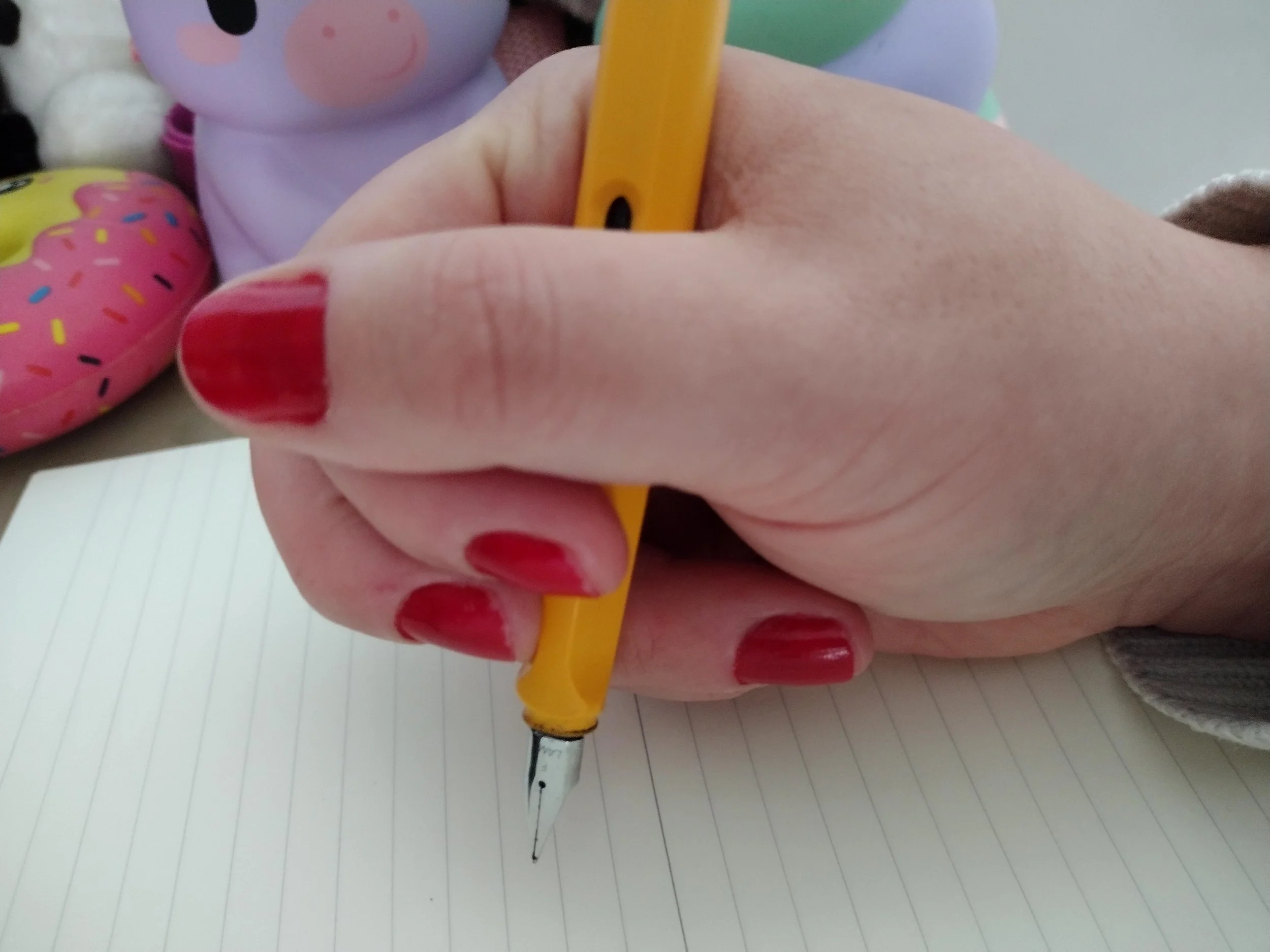
As you can see, my grip doesn't look like any of the "correct" or traditional ones previously described. My whole hand closes around the pen in something closer to a fist than a pinch. The pen sits diagonally across my palm instead of resting in the web between my thumb and index finger. My thumb wraps over the top of the barrel and presses down and across it, rather than pinching from the side the way a tripod grip would have you do it. My index and middle fingers curl underneath to brace the pen from below, and my ring and pinky fingers clamp in tight against my palm, adding pressure rather than staying out of the way like they're supposed to. By the time the nib reaches the page, it's pointing back toward my wrist at a steep angle instead of extending forward the way a "normal" grip would have it.
It's not really any of the grips I listed above. It's closer to a fist grip than anything else, but unlike the palmar grip children use, my fingers are actively working to brace and stabilise the pen rather than letting my whole arm do the movement. My hand is doing the job that, in a standard grip, would be split between two or three specialised fingers. That gets tiring, but without it I would not be able to write or draw. The compromise is the pen or pencil digging into the skin on my fingers because of the added pressure my grip introduces.
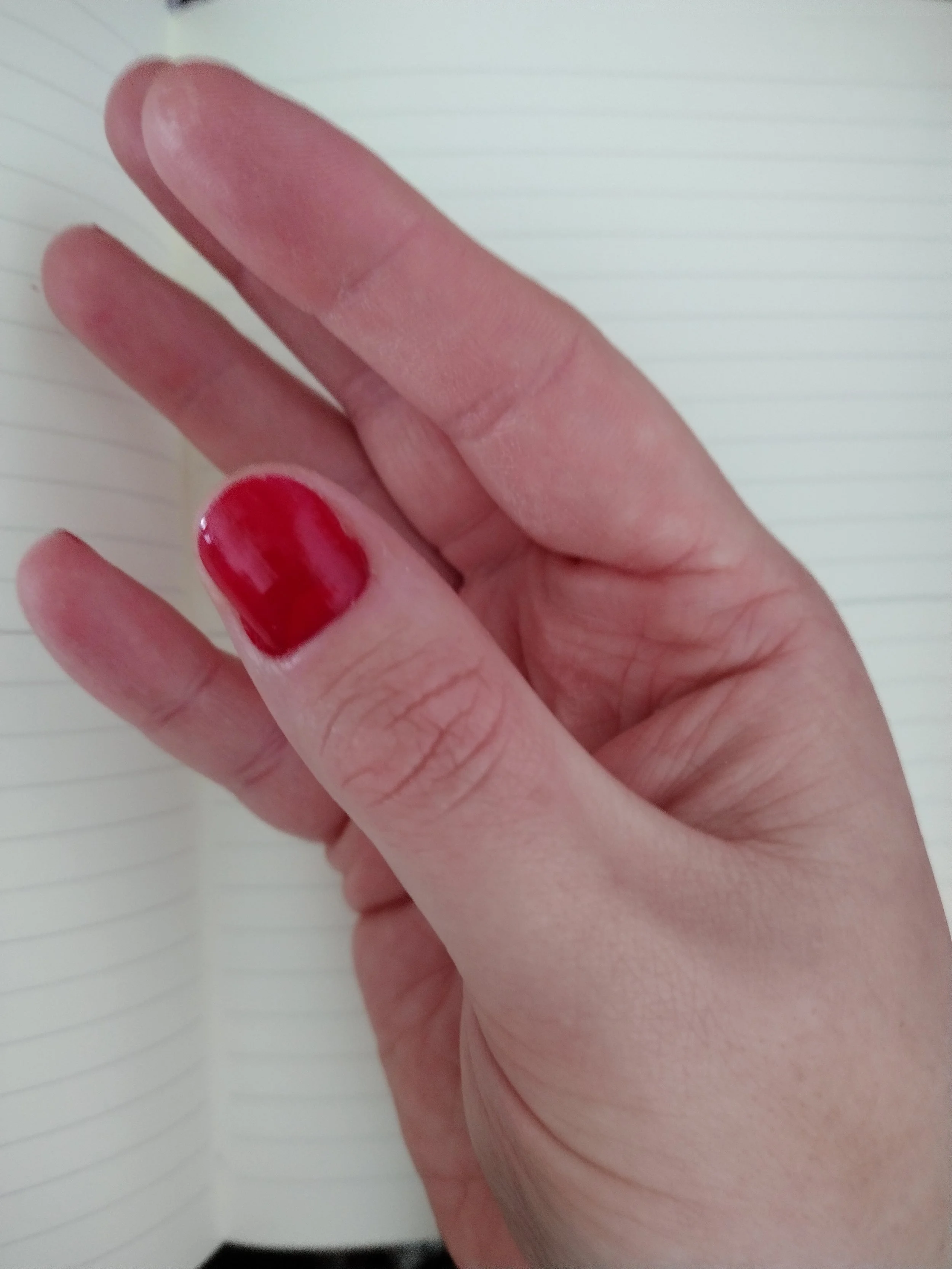
Photograph of the way my hands cramp up after a short time of writing or drawing.
I didn’t actively go looking for this unique grip as a solution; it was something that naturally developed in childhood during “handwriting lessons” and my love for drawing. I needed to be able to keep up with my peers, so my body just found its own compromise. It wasn’t perfect; it still hurt, I was still a slower writer than everyone else, but it allowed me to keep up just enough. I have tried over the decades to use the traditional pencil grips taught by nearly every book and artist when I have wanted to improve my draughtsmanship, but I found they all removed my ability to draw due to increased pain and lack of control.
As a multidisciplinary artist, I also work with digital pens and find the same problems remain as with traditional media. However, some digital work does become easier, especially for clean illustrations. This is because many illustration applications have adjustable stabilisation settings for your pen. There are also tools like the “line” tool and guide lines that can help with tracking where my lines are going across the page as well as making straight lines without effort. Despite this, I still find that my hand does get tired, painful, and cramps. You’d think this would make me more drawn to digital illustration as an artist, and whilst I do enjoy exploring this, I find myself enjoying the expression in traditional media more.
You see, being Dysgraphic does affect how I work and what outcomes I achieve. I have so far only focused on what the limitations of being Dysgraphic are, which isn’t the whole story. I also find some benefits in being Dysgraphic:
I have a unique artistic style which I feel is seen throughout my artwork with a heavy hand and boldness.
Lines (both tangible and intangible lines) have become important subjects in my work, and I don’t think that would exist without my difficulties in being able to track my own pencil across a page.
My brain has had to think differently from other people naturally in order to discover its own solutions to my limitations.
I can write and draw with both hands using my own unique grip through practice and necessity (to keep up with time constraints), which many people cannot do.
If you're Dysgraphic and reading this, remember what's actually happening the next time your hand locks up in that meeting, or the burning starts a few moments into a sketch. That's not you failing to keep up. That's a brain that's been solving this problem since childhood, still solving it now, refusing to stop just because it hurts. You found your own grip once. You can keep finding your own way through.
For everyone else: difference isn't a deviation from the "correct" way of doing things; it's just another way of doing them. The tripod grip isn't correct; it's just common. Some of the most interesting thinking, drawing, and problem-solving comes from people whose hands, brains, or bodies never fit the standard version of anything. So when a colleague pauses to shake out their hand mid-meeting, or an artist holds their pencil in a way that looks "wrong" to you, don't correct them. Don't stare. Just let them work the way their body actually works.