Ziz mythology: Step into the light, sit in the darkness
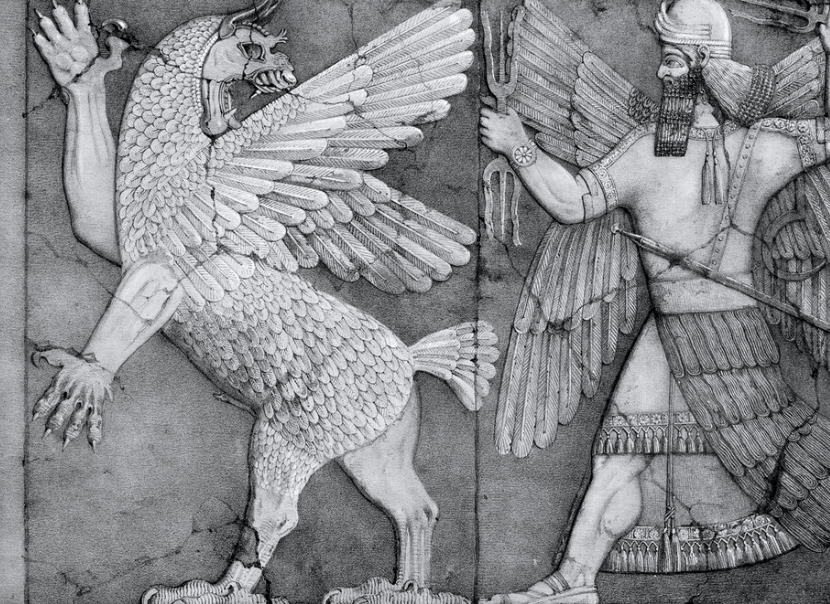
Ziz is widely believed to be modelled on the Sumerian Anzu (All About Ziz – Jewish Mythology’s Giant Bird | Mythology Planet)
What is the Ziz in mythology?
TDLR: In Ziz mythology, the great mythic bird rises between light and darkness, stretching its wings across heaven and earth. Rooted in Jewish tradition, the Ziz is said to be so vast it can eclipse the sun, yet its true power lies in balance rather than domination. This ancient symbol invites us to step into the light while remaining willing to sit in the darkness, holding both as necessary parts of spiritual awakening.
Every New Moon, I light candles, pour libations to Hestia and Hekate, make my offerings, and burn incense resins on a charcoal disc. The heady aroma of rosemary, saffron, lemon, and storax fills my lungs, preparing me for Shadow Work.
I grab my deck of "Oracle of Pluto" and get comfortable, ready to face truths about me, however uncomfortable that might be.
This month's New Moon reading contained the Griffin. As it is an oracle deck rather than the Tarot, I often refer back to the guidebook that comes with the deck. Within its guide, it stated the following:
"Sometimes the Griffin is depicted as being so large that it can blot out the Sun. In this form, the Griffin is known as Ziz, a creature from Jewish mythology that can also allow the light of the Sun to come through if it so chooses. In both darkness and light, there are different experiences and truths to be found. There is a time to sit in the dark and silence, and a time to step out into the illumination and warmth of the Sun."
Oracle of Pluto Guidebook
Light and dark
As always, it was funny to me how literal the cards were, as this card in particular reflected me asking how I can achieve a homeostasis between my light and shadow energies. All too often in Witchcraft and Pagan communities, there is a focus on “love and light,” but is this the only way to be whole and content? For me, darkness and light are both sacred states that are equally needed. When the Ziz blots out the Sun, it is not necessarily a bad thing. The earth we walk on is not about to descend into evil chaos, despite what superstitions around solar eclipses may say. Instead, it affirms that darkness is not a failure or an absence of spirituality, but a distinct state, akin to the Dark Moon, winter, and descent myths.
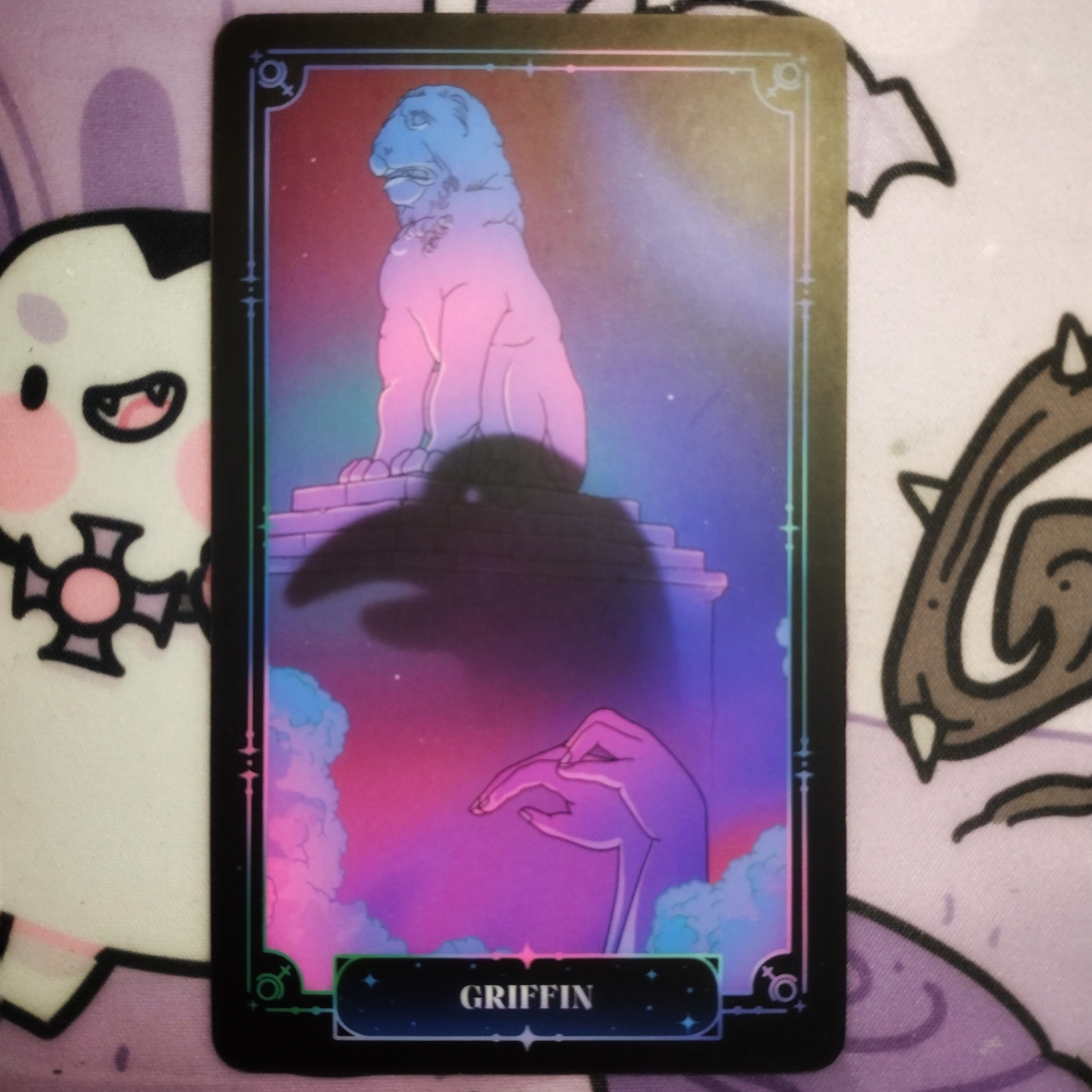
The Griffin card from the Oracle of Pluto deck.
Many Pagan religions and practices emphasize cycles and thresholds, as exemplified by the Wheel of the Year and the Druidic Cycle of the Year. Our Lord of Light, Apollon, leaves Delphi each year, giving Dionysus guardianship during the dark winter months, only to return when the light does. Like Apollon, illumination is most potent when approached intentionally, after time spent in reflection within darkness. As a community, we need to normalize the act of sitting in darkness and walking into the light as conscious choices, rather than making light a constant demand.
Sitting in the dark allows truths to emerge that light cannot reveal. This can take the form of silence, shadow work, and liminal states. Drowning ourselves in frenzied activity and the Seen, as opposed to the Unseen, such as the Chthonic Gods, can blind us to what is within and all around us. Darkness is a womb of understanding, where intuition, ancestral memory, and inner voices can be heard. But you may cry, “Why invite darkness into your life?” Light is not diminished by darkness; however, it is defined by it. Accepting darkness helps us cultivate reverence and gratitude rather than fear of the shadow.
The homeostasis that the Griffin card in the Oracle of Pluto deck speaks of is a dynamic rather than a static relationship. The teaching is not “half light, half dark,” but movement between them. Let us honour the growth, healing, and transformation that withdrawal and emergence in both states of light and dark can bring.
I think it is also important to remember that, like the Ziz, we can choose whether to allow light through. We are not passive participants in the cycle of light and dark. We actively engage with it. In our lives, we consciously work with cycles of concealment and revelation in our identity, rituals, and personal paths. We are not ruled by these cycles unconsciously. We are in charge of our own path, and we wield our will.
Taken together, this passage teaches that stepping into the light and sitting in the dark are not opposites to be reconciled, but complementary acts of sacred awareness, each necessary, each chosen, and each carrying its own wisdom. With all of this in mind, learning more about the design of the oracle card led me to wonder, what exactly is the Ziz, and what else might it teach me?
Ziz mythology and what else it teaches us
In Ziz mythology, the Ziz is a vast mythic bird from Jewish tradition, embodying the balance between light and darkness, heaven and earth.
According to Wikipedia, the Ziz is “a giant griffin-like bird in Jewish mythology, said to be large enough to block out the sun with its wingspan.” It is often thought of as, or inspired by, myths of Anzu. In the journal article Anzu and Ziz: Great Mythical Birds in Ancient Near Eastern, Biblical, and Rabbinic Traditions, the author notes a “…representation of insubordinate forces by the elements of water. The turbulent, uncontrollable qualities of water pertinently depict chaos” in Near Eastern mythology, particularly in the primordial Chaoskampf.
Chaotic forces were also embodied in other mytho-poetic figures, such as the Bull of Heaven in the Epic of Gilgamesh and the Mesopotamian Labbu. Anzu, like Labbu, is a chimera-like creature appearing as an eagle with a lion’s face, much like the Ziz and the Griffin. Its most prominent feature is its gigantic size:
“In the Sumerian Epic of Lugalbanda, Anzu nests within a tree of extensive dimensions, its roots penetrating the seven-headed river of Utu, the sun god. Anzu hunts wild oxen in the eastern mountain range and carries them to its nest by its talons and around its neck to feed its young. When flapping its broad wings, Anzu could cause wind whirls and sandstorms.”
Water and chaos
For many, water symbolizes formlessness, potential, and uncontrollability, much like Oceanus surrounding the ordered world, leaving the sea ancient and untamed. Chaos, however, is not inherently negative. As we know from the Big Bang theory, chaos can generate life and create new possibilities. The Ziz teaches a similar lesson: chaotic forces can be powerful and transformative, if approached consciously.
“At dawn Anzu spreads its wings and roars with a frightening voice in the direction of the Sun, rising in the mountains, causing the land to tremble.”
Like the Ziz, humans can harness chaos to drive change. In activism, this might mean speaking out or protesting to hold authority accountable, “roaring with a frightening voice” to effect transformation, without necessarily dismantling everything dramatically.
The Ziz, Leviathan, and Behemoth
According to aggadic tradition, Ziz is a proper name denoting a legendary giant bird whose role parallels Leviathan and Behemoth. The Ziz represents the sky, Leviathan the waters, and Behemoth the terrestrial realm. Together, they embody the entire living environment.
“Together the three represent the entire living environment. The affinity is not only in their gigantic size but also in their shared fate. The three creatures will serve as the main course at the messianic banquet for the righteous in the world to come.
"He will then show them three constellations
Ziz and Leviathan and Behemoth
Ziz who feeds them with all sorts of tastes
Spreads its wings mightily
And dims the luminaries as far as the deeps”Piyyut of Qalir"
Their size highlights their chaotic and rebellious nature, which often led to suppression by God in mythic narratives:
“Open your mouth and swallow all the waters of the world… To Him, Lord of the universe, it is enough that I remain my own. Thereupon, He struck him with His foot and killed him, for it is written: By His power He stilled the sea. By His skill He struck down…”
Ziz mythology and shadow work
As I write this on the morning of the Winter Solstice, the rebirth of the Sun, many Pagan festivals celebrate the Sun’s return. They look forward to the year ahead, but often forget the lessons learned in darkness. We should be more like the Ziz, able to find wisdom in both light and dark.
Chaos has its place, but must be balanced with self-discipline. Sitting in darkness is vital for inner reflection and growth, yet remaining too long can trap us in confusion. Conversely, walking in the light without pause can blind us to hidden truths and prevent us from acting against forces that would harm us. The Ziz teaches that embracing both states, while consciously choosing when to step into light or darkness, allows us to navigate the world with awareness and power.
Ziz Mythology FAQ
-
A: In Ziz mythology, the bird symbolizes balance between opposing forces, particularly light and darkness, spiritual elevation and earthly grounding.
-
A: The Ziz is neither purely benevolent nor destructive. In mythology, it represents integration rather than moral extremes.