From Vandalism to Violence: Why Labelling Hate Speech Accurately Matters
Language shapes reality. The words we choose to describe harm determine how seriously that harm is understood and how urgently it is addressed. When acts of hate are reduced to “graffiti” or “vandalism,” something essential is erased. The intent, the target, and the impact are softened into something almost mundane. But Hate Speech is not mundane. It is not neutral. It is never just surface damage.
During Pride Month 2025, Diest’s Rainbow Bridge in Belgium, a public symbol of inclusion and LGBT+ pride, was defaced with homophobic graffiti. The message was neither random nor meaningless. It was targeted. It was hostile. It was designed to intimidate and exclude. Yet, when such acts are officially categorised as mere vandalism, the deeper violence embedded within them is obscured.
This distinction matters.
Calling Hate Speech “vandalism” frames it as an attack on property. Calling it what it is, Hate Speech, acknowledges that it is an attack on people.
The Measurable Harm of Hate Speech
Academic research consistently shows that hate-motivated acts cause greater psychological and social harm than comparable non-hate incidents. Research by Mellgren et al. (2017) demonstrates that hate-motivated crimes result in more severe consequences than comparable non-hate incidents¹, and more recent analysis using US national victimisation data shows that victims of hate-motivated offences experience greater long-term emotional and physical harm, even where initial injuries are comparable.²
Victims of hate crimes report heightened levels of fear, anxiety, depression, and loss of confidence compared to victims of offences without hate motivation. This harm is intensified because hate incidents are not perceived as isolated. They are understood as attacks on identity and belonging.
Even when the act appears minor, such as vandalism, the presence of hate motivation changes its impact significantly. Studies show that hate-motivated vandalism produces stronger emotional responses than equivalent non-hate incidents, reinforcing the understanding that hate causes deeper harm.
This is particularly important in the context of graffiti. When hateful messages are written in public spaces, they function as environmental signals of exclusion. They communicate who belongs and who does not.
Research also demonstrates that victims of hate incidents experience a greater sense of insecurity in their own neighbourhoods, with many reporting fear even in everyday settings. Studies consistently show that victims of hate crimes (such as Hate Speech) experience more severe emotional distress, including fear, anxiety, and loss of confidence, largely due to the targeted nature of these acts and their impact on identity and belonging (Mellgren et al., 2017; Benier, 2017; Holder, 2024).³ In this way, Hate Speech graffiti does not just affect individuals; it reshapes entire communities.
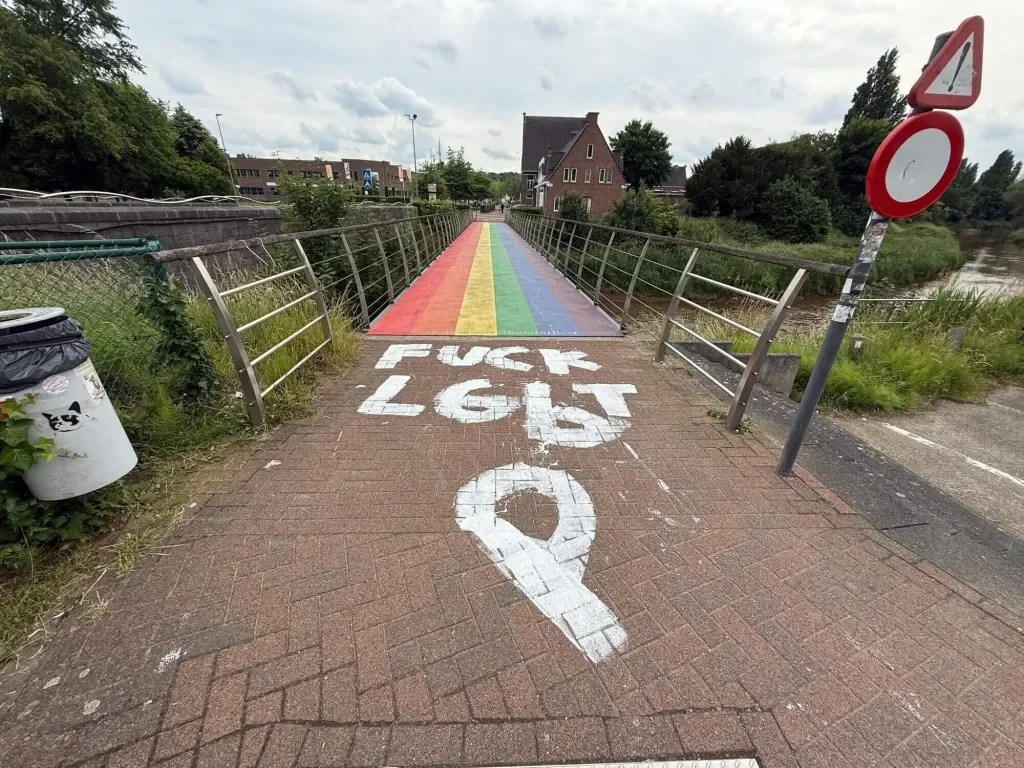
Diest’s Rainbow Bridge, originally painted as a beacon of inclusivity and pride, desecrated during Pride Month 2025 by homophobic Hate Speech graffiti.
Why Naming Matters
When local authorities describe incidents such as the defacement of Diest’s Rainbow Bridge with Hate Speech graffiti as vandalism, they are not merely choosing a word; they are defining the limits of their response. Vandalism can be cleaned. Hate Speech must be addressed.
This mislabelling has several consequences:
It reduces perceived severity. Treating Hate Speech as minor property damage diminishes its social and psychological impact.
It obscures intent. Hate Speech is targeted and directed at specific identities. Vandalism is not.
It weakens institutional response. If something is framed as a low-level disorder, it is less likely to be investigated, prosecuted, or publicly condemned with urgency.
It contributes to normalisation. When hate is not named, it becomes easier to ignore and easier to repeat.
Scholars have long argued that hate crimes carry a broader message effect. They are not only attacks on individuals but symbolic acts aimed at entire communities. Misnaming them disrupts our ability to respond appropriately to that wider harm.
Failing to name Hate Speech as such allows it to fade into the background of everyday life. And when hate becomes background noise, it becomes easier to ignore, easier to repeat, and ultimately, easier to accept.
As the accompanying statement from the artist makes clear:
“During Pride month, 2025, an act of Hate Speech was graffitied on the Rainbow Bridge in Diest, Belgium. The local authorities have only treated this horrendous act as an act of vandalism, but it is so much worse than that. It is an act of Hate Speech. Belgian authorities need to call these acts out for what they are - Hate Speech.”
— Kaye Outhwaite, 08/09/2025
The Ongoing Effects
In March 2026, Kaye Outhwaite discovered Swaskita’s on the wall near his home. As a member of the LGBT+ community, this was deeply concerning, and he believes it is a direct result of the wrongful naming of the previous Hate Speech found on the rainbow bridge in June 2025 as mere “graffiti” and “vandalism”.
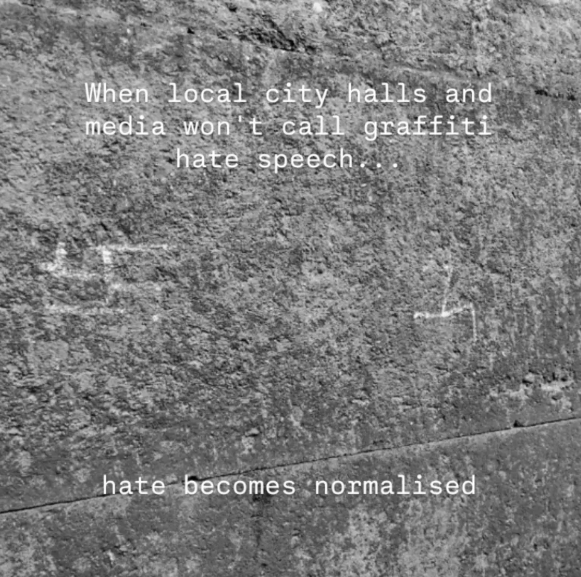
Hate Speech discovered in the Diest, Belgium area in March 2026.
Enough was enough, so on 20th March 2026, Kaye Outhwaite contacted the Diest City Hall to request information on Graffiti Cleaning Data during 2025; he wanted to see if the City Hall was tracking these incidents at all and to request permission to create a peaceful and positive artistic response at the rainbow bridge in June 2026. He asked for:
The total number of graffiti incidents that required cleaning or removal;
Whether the city categorises or records the nature of the graffiti;
If so, how many of these cases involved Hate Speech, including but not limited to racist, homophobic, transphobic, or other forms of discriminatory or offensive content.
And he proposed a project that would consist of creating positive, inclusive messages in support of the LGBT+ community, using washable chalk on pavements.
This initiative was intended as a form of constructive and respectful expression, promoting inclusivity, diversity, and mutual respect. It is also conceived as a response to the Hate Speech graffiti that appeared on the Rainbow Bridge during Pride Month in 2025, with the aim of fostering a more welcoming and supportive atmosphere in our shared public spaces.
As of 5th May 2026, there has been no response from Diest City Hall to either the data request or permission for a peaceful and positive artistic response to the Hate Speech. Kaye Outhwaite is planning an alternative project that does not require permission from the local authorities, but will continue to keep asking the City Hall to remain responsible for turning a blind eye to Hate Speech in the local area. One such initiative has been to request the City Hall refresh the rainbow bridge and add the Progressive flag in Diest, especially as they have found the funds to create a new bicycle path in the area, they can use some of the funding to tidy up the bridge as a small gesture of goodwill towards the local LGBT+ community.
“To call Hate Speech “graffiti” is to minimise it.
To call it “vandalism” is to misdirect it.
To call it what it is, Hate Speech, is to confront it.
And confrontation is where change begins.”
- Kaye Outhwaite 05/05/2026
If harm is not named accurately, it cannot be challenged effectively. And if it is not challenged, it risks becoming part of the landscape, unnoticed, unchallenged, and ultimately accepted.
Sources
For Whom Does Hate Crime Hurt More? A Comparison of Consequences of Victimization Across Motives and Crime Types [accessed 05/05/2026]
Revisiting the Harm of Hate A Quasi Experimental Approach Using the National Crime Victization Survey [accessed 05/05/2026]
The Harms of Hate Comparing Neighbourhood Impacts of Hate Crime and Non Hate Crime [accessed 05/05/2026]